Composite objectives are reward models, and ours was hacked in ninety-five minutes
Your independence check isn’t independent
- cheminformatics
- BioML
- research
1. Composite objectives are reward models
Early-stage drug discovery increasingly decides what is worth making before anything is made. Models trained on public assay data estimate properties — solubility, metabolic liability, cardiac toxicity — for compounds that exist only as strings, and generative or search-based systems propose new compounds that are ranked by exactly those models, with a chemist seeing only what survives.
Scalarising several learned property predictors and handing the result to an optimizer is standard practice in that setting, and structurally it is reinforcement learning against a learned reward model. The expected failure is the same: the optimizer maximises the predictor rather than the property the predictor estimates. That this occurs is established. Renz et al. (2019) demonstrated it for molecular optimization and introduced the control design we adopt here; Langevin et al. (2022) reproduced it across three optimizer families; Gao and Coley (2020) quantified the synthesizability failure and the cost of constraining against it. That our optimizer breaks the objective, that it does so by leaving the chemistry the predictors were fit on, and that constraining it back costs objective score are therefore replications, and we do not offer them as new.
The question we address is narrower and, we think, more useful: given that the failure occurs, would a conventional audit detect it? We therefore pre-registered three detection instruments and one mitigation before running the experiment, and report what each saw.
2. The Method - Our Pipeline
Objective. Five components: aqueous solubility (AqSolDB), hERG blocker probability, CYP3A4 inhibition and Caco-2 permeability, all from ADMET-AI’s pretrained Chemprop ensembles, plus RDKit QED. Each is mapped to its percentile against the 2,845-molecule DrugBank reference set and combined by weighted geometric mean, chosen so that no component can be fully sacrificed.
Optimizer. A SELFIES genetic algorithm implemented in-repo: token substitution, insertion and deletion, population 200, 100 generations, elitism at 10%, tournament selection. SELFIES guarantees syntactic validity, so the result cannot be attributed to invalid-SMILES handling. Five seeds per arm; 458,519 molecules evaluated in total; top-100 distinct molecules reported per seed.
Arms. D, a random sample of the starting library; R, the approved drugs, scored but never optimised; A, unconstrained optimization; B, an applicability-domain penalty below ECFP4 Tanimoto θ ∈ 0.5 to the predictors’ training set; C, arm B at θ = 0.40 plus a synthesizability penalty.
Audit instruments. (i) Per-endpoint spread across each ADMET-AI ensemble’s
five members. (ii) Independent scorers following Renz: LightGBM over RDKit
descriptors and MACCS keys, in three variants — trained on the full TDC
train_val split, on a deterministic half of it, and on the TDC test split.
Because ADMET-AI is a fixed artifact fit on all of train_val, only the third
is genuinely disjoint from the objective’s training data; the second was
nonetheless pre-registered as the headline oracle. Independent scorers exist for
hERG and solubility only. (iii) A structural implausibility battery, a molecule
failing if it violates at least two criteria, with thresholds calibrated against
arm R so that ≤5% of approved drugs are flagged (achieved 4.9%) and frozen
before any arm A molecule was generated.
Decoupling detector. Per generation, elite sets were scored by both the objective and each independent scorer; decoupling is recorded at the first generation where their gap exceeds its generation-0 value by a declared margin for three consecutive generations.
3. Results
3.1 The objective saturates beyond the approved-drug range
| arm | objective (mean ± sd) | percentile vs. approved drugs |
|---|---|---|
| D — random library sample | 0.327 ± 0.013 | 34.5th |
| R — approved drugs | 0.425 | 50th by construction |
| A — unconstrained | 0.886 ± 0.010 | 100th |
| B, θ = 0.50 | 0.840 ± 0.009 | 99.9th |
The highest-scoring approved drug reaches 0.847. All 500 arm A molecules across five seeds exceed it; the distributions do not overlap. All four learned components saturate together (0.902–0.946 in DrugBank-percentile units). QED, the only non-learned component, is the least saturated at 0.761 and is the binding constraint on 93% of arm A’s reported molecules. Arm A’s output spans 4.8 Murcko scaffolds per seed on average; arms B and C span one; a hundred random library molecules span 97.
3.2 The exploit does not depend on exotic ionisation states
Arm A converges on a tetrahydropyran core bearing carbanion or carbocation centres and a C–Br bond. Restricting to the 85 reported molecules that are both battery-clean and charge-neutral leaves the mean objective at 0.883, and all 85 still exceed the best approved drug. Mean molecular weight is 208 Da in arm A and 132 Da in arm B θ = 0.50, against 386 Da for approved drugs; mean ring count falls from 2.6 to 0.2 and 0.0 respectively.
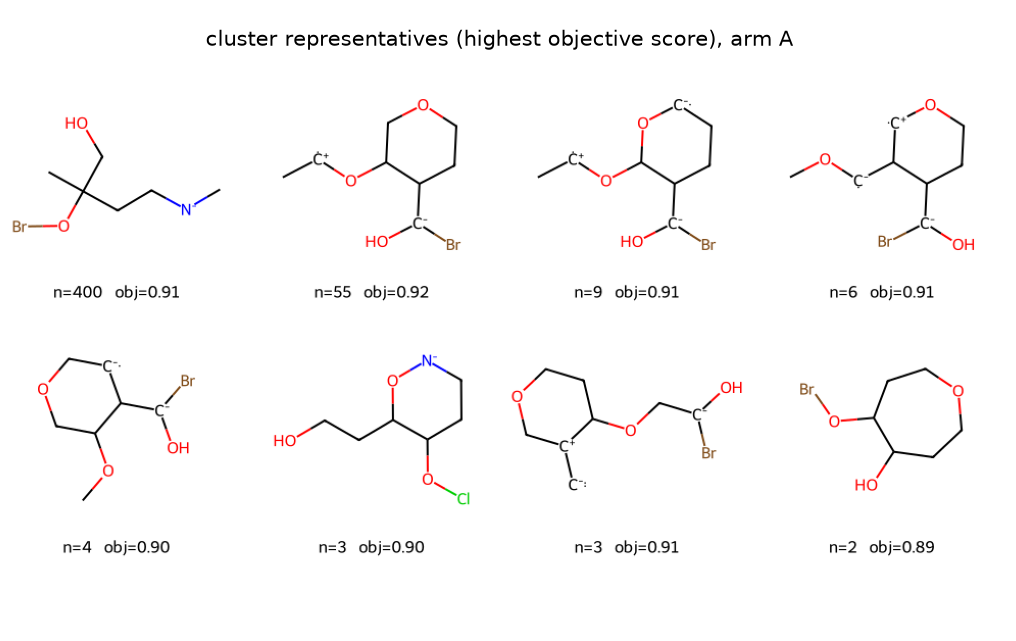
Figure 1. Murcko scaffold clusters of arm A’s reported molecules, with the highest-scoring representative of each. Cluster sizes are pooled across five seeds; 400 of 500 molecules are acyclic and a further 55 share the tetrahydropyran core.
3.3 Ensemble spread contracts on the exploited molecules
| per-endpoint ensemble sd | arm A | arm R |
|---|---|---|
| hERG | 0.005 | 0.063 |
| CYP3A4 | 0.000 | 0.054 |
| Caco-2 | 0.150 | 0.140 |
| solubility | 0.357 | 0.311 |
On both classification endpoints ensemble members agree substantially more on arm A than on approved drugs.
3.4 Divergence is detected only by the data-disjoint scorer
Spearman correlation between the objective’s predictor and the independent scorer:
| population | pre-registered (shares data) | disjoint |
|---|---|---|
| starting library | +0.807 | +0.774 |
| approved drugs | +0.875 | +0.835 |
| arm A | +0.117 ± 0.223 | +0.106 ± 0.179 |
| arm B θ = 0.30 | +0.544 ± 0.124 | +0.413 ± 0.170 |
| arm B θ = 0.50 | +0.649 ± 0.149 | +0.580 ± 0.147 |
Agreement recovers monotonically as θ tightens. The hERG channel of this test is uninformative: in arm A the objective’s hERG predictions have sd 0.0044 and the pre-registered scorer’s 0.0007, so per-seed correlations (−0.33 to +0.39) are noise between two near-constants, and the corresponding mean absolute disagreement falls from 0.20 on arm R to 0.016 on arm A. In level terms, arm A’s mean hERG prediction is 0.016 from ADMET-AI, 0.001 from the pre-registered scorer and 0.211 from the disjoint scorer.
Per-generation decoupling in arm A (Figure 2), seeds detected out of five:
| margin | model control | pre-registered | disjoint |
|---|---|---|---|
| 0.05 | 2/5 | 2/5 | 5/5 |
| 0.10 (primary) | 1/5 | 0/5 | 5/5 |
| 0.15 | 0/5 | 0/5 | 5/5 |
The pre-registered result is null. The disjoint scorer detects decoupling at generations 9–51, after which the objective holds near 0.94 while the independent estimate peaks at 0.79 and declines to 0.65; mean maximum gap 0.248 against 0.040 for the pre-registered variant.
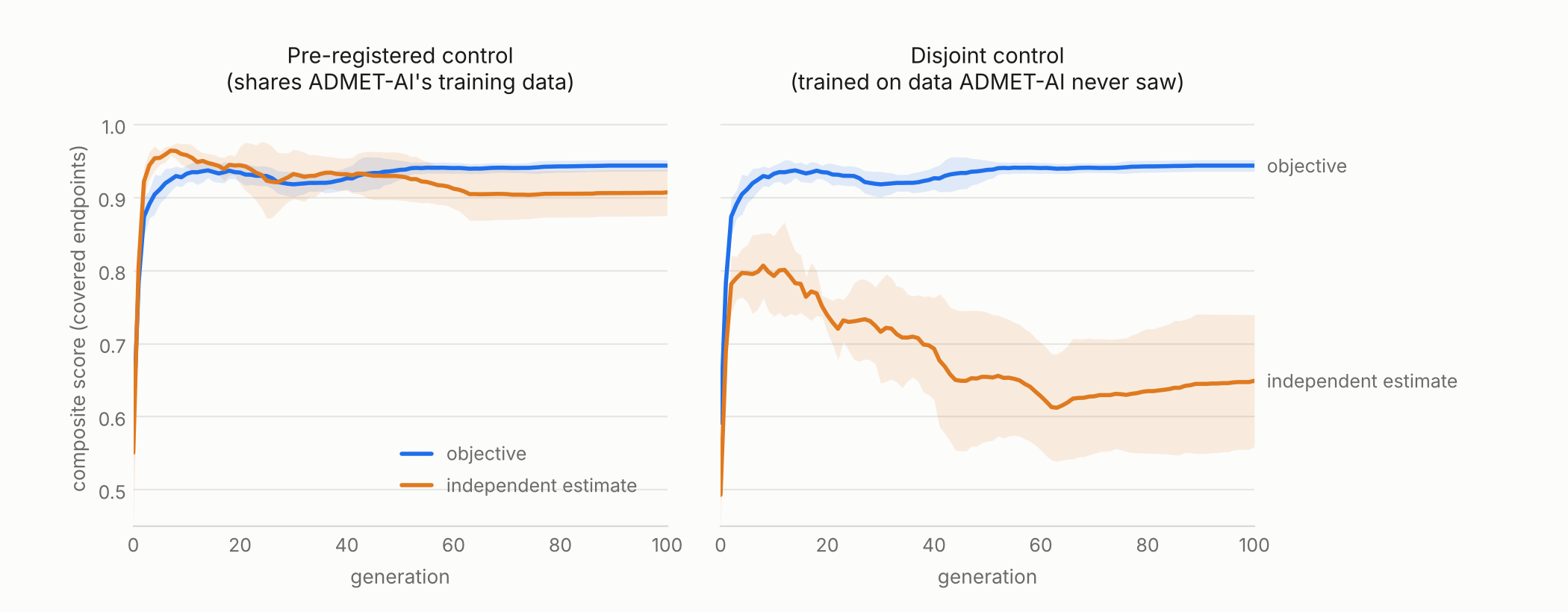
Figure 2. Objective score and independent estimate of the per-generation
elite set, arm A, mean across five seeds with ±1 sd. Left: the pre-registered
independent scorer, which shares ADMET-AI’s training data. Right: the same
recipe trained on the disjoint TDC test split. Only covered endpoints (hERG,
solubility) enter both series.
3.5 The plausibility battery flags through one criterion
The frozen battery flags 82.4% ± 16.0% of arm A. Of its eight criteria, one — implausible charge centres — accounts for 0.82; synthetic accessibility accounts for 0.06; the remaining six fire on nothing. Every continuous criterion in the battery is an upper bound.
The fraction of reported molecules that are both acyclic and under 250 Da is 0.79 in arm A, 1.00 in arms B θ ≥ 0.40 and C, 0.004 in the random library sample and 0.115 among approved drugs. The battery scores 76% of arm B θ = 0.50 as plausible.
Applying the battery’s own calibration rule to the lower tail yields MW ≥ 100 Da, which flags nothing (optimised-arm median weights are 124–207 Da), and no admissible ring criterion, since 16.6% of approved drugs are acyclic. Adding “acyclic counts as a failure” would raise arm B θ = 0.50 from 0.238 to 0.352 while flagging 10.0% of approved drugs, twice the pre-registered ceiling. This counterfactual is post-hoc; the battery was not modified.
3.6 The applicability-domain constraint trades score for flagged implausibility
| arm | objective | implausibility | mean similarity to training data |
|---|---|---|---|
| A | 0.886 ± 0.010 | 0.824 ± 0.160 | 0.254 |
| B θ = 0.30 | 0.864 ± 0.011 | 0.492 ± 0.191 | 0.413 |
| B θ = 0.50 | 0.840 ± 0.009 | 0.238 ± 0.036 | 0.583 |
Implausibility falls by 0.254 and the objective by 0.024 across the sweep. Arm C is a null condition: mean SA 4.09 against arm B θ = 0.40’s 4.03, with no molecule in either crossing the penalty’s threshold, which binds only in arm A (50% of reported molecules).
4. Discussion: instruments that inherit their blind spots
Two of these results are properties of the audit rather than of the optimizer, and both generalise past chemistry.
Independence is a property of training data, not of architecture. The pre-registered oracle differs from ADMET-AI in architecture, featurization and hyperparameters, and shares its labels. It certified arm A: no decoupling in any seed, and a hERG estimate four times lower than the objective’s own. The same recipe trained on disjoint data detected decoupling in every seed and gave a hERG estimate thirteen times higher. An audit trained on the same data inherits the same blind spot, so holding out the architecture while reusing the benchmark buys almost nothing — a condition that is hard to satisfy wherever a field reuses a small number of public splits, as cheminformatics reuses TDC’s.
A filter inherits the permissiveness of its reference set. Calibrating against approved drugs is methodologically correct and was blocking in our pre-registration, precisely because an uncalibrated battery that flags most real drugs is uninterpretable. The cost is that the filter inherits the diversity of approved drugs, which include small acyclic compounds. Our optimizer moved toward fragment space, where every continuous criterion — all upper bounds, all built for the way generative models usually fail — is silent, and §3.5 shows no lower bound could have been admitted at the same calibration. The blind spot is structural, not a thresholding error.
Ensemble spread adds a third, weaker case of the same pattern: members sharing an architecture, a featurization and a training set agree where they have learned the same shortcut, so their agreement cannot measure competence outside that set. Confidence-gated filtering would have ranked arm A’s molecules among the run’s most reliable predictions.
The mitigation result should be read with §3.5 in hand. The applicability-domain constraint cuts flagged implausibility by 71% for 5% of objective score, which is an excellent trade and the one practice we would recommend adopting. But arm B θ = 0.50 still scores at the 99.9th percentile and consists entirely of sub-250 Da acyclic chains: the constraint removed the exploit the battery detects and left one it cannot, and the implausibility column records that as an improvement. Notably, no arm optimised an objective containing any notion of plausibility; every constraint acted on the search space rather than on the score.
Accordingly, a follow-up should pre-register the data-disjoint scorer as the headline oracle; a fragment criterion calibrated against a reference set other than approved drugs, with its own declared ceiling; independent scorers for all four endpoints; a redesign or removal of arm C; and a plausibility term inside the objective rather than only in the reporting.
5. Limitations
Only two of four learned endpoints have independent scorers, so exploitation routed through Caco-2 or CYP3A4 is invisible to the disjoint scorer. The independent scorers are themselves imperfect (disjoint variant: hERG ROC-AUC 0.826, solubility MAE 0.881 log units), so some measured divergence is oracle error; the decoupling detector triggers on change relative to generation 0 to cancel constant offsets. The applicability domain is computed over ECFP4 while the objective’s predictors are message-passing networks, so arm B constrains a proxy. Reported implausibility is a lower bound. One optimizer family, one objective composition, no docking, no synthesis, no assay. Nothing here was measured in a laboratory: the ground truth throughout is one model’s estimate checked against another’s. The molecules reported are artifacts of an adversarial search procedure and are not drug candidates. None of this is a criticism of ADMET-AI or TDC, which are well-built resources used here outside their intended regime.
6. Conclusion
A conventional audit with: held-out architecture, ensemble uncertainty, a calibrated structural filter, failed to detect a reward-hacking failure that was obvious on inspection, and failed for reasons that were properties of how the audit was constructed. Only the instrument trained on disjoint data detected it, in every seed. The cheapest durable fix is probably not a stricter filter downstream but an objective that is harder to maximise in the first place.
References
-
Renz, Philipp, et al. “On failure modes in molecule generation and optimization.” Drug Discovery Today: Technologies 32 (2019): 55-63.
-
Langevin, Maxime, Rodolphe Vuilleumier, and Marc Bianciotto. “Explaining and avoiding failure modes in goal-directed generation of small molecules.” Journal of Cheminformatics 14.1 (2022): 20.
-
Gao, Wenhao, and Connor W. Coley. “The synthesizability of molecules proposed by generative models.” Journal of chemical information and modeling 60.12 (2020): 5714-5723.
Links
Repository, pre-registration, deviations log and machine-generated per-seed
results: [link will be added soon]. make reproduce regenerates every number above.